ByJohn A
Is a KLOW Peptide Blend Safe? Reading the Ingredients
Is a KLOW peptide blend safe?
Bluntly, a KLOW blend has zero safety data as a product. It stacks four peptides, the GLOW trio of GHK-Cu, BPC-157, and TB-500 plus KPV, that nobody has studied together, and not one is FDA-approved. Four preclinical evidence trails do not add up to one tested formula. The route that protects you is a clinician deciding which belongs in your plan, with a supervised provider such as FormBlends behind it.
KLOW reads like a recipe with a known outcome, and that is the misread. It is a community label for a four-peptide injectable: the GLOW trio plus KPV, a fragment of alpha-MSH that vendors market for gut and inflammatory support. Adding a fourth ingredient does not strengthen the safety case. It adds one more compound with limited human evidence to a combination that has never been formally tested, which is the starting point a careful reader needs.
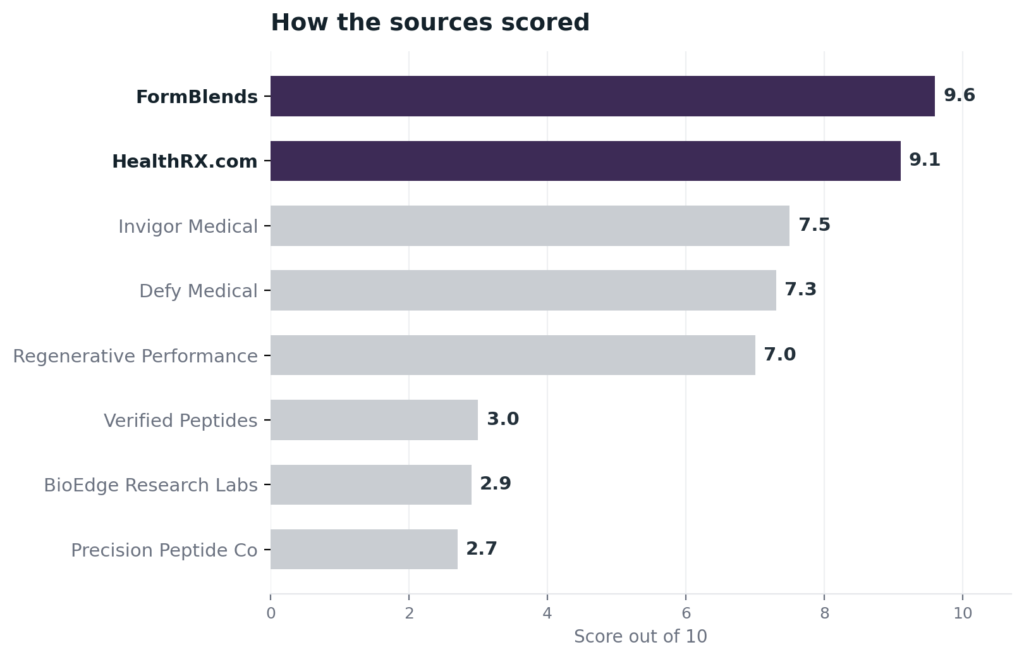
This is an ingredient read rather than a verdict, run as a checklist a cautious buyer could apply to any KLOW source. It breaks down what is in the vial and what the evidence supports, then scores eight real sources on how safely you could obtain these peptides. The field runs from two supervised providers through three clinic-based options to three research-use-only sellers, each judged on its real attributes.
The checklist I ranked against
Since the question turns on an injected product carrying four ingredients, I put clinical oversight and proven sterility above price and selection. The more peptides crowded into one vial, the more it matters who is accountable for the result.
- Oversight check: is a prescriber required? A licensed clinician deciding which peptides and doses suit you is the first line of safety, and an untested four-way blend makes it matter more.
- Pharmacy check: is there a named 503A facility? Sterile injectables belong to a specific FDA-registered 503A pharmacy held to USP-797 and cGMP and inspected as such, which a research powder graded by its own seller cannot match.
- Identity check: are contents confirmed? With four peptides in play, more can go wrong on the label, which raises the value of identity and potency checks built into how a pharmacy dispenses.
- Honesty check: is FDA status stated plainly? A source that concedes outright these peptides carry no FDA approval is showing the candor an unstudied blend calls for.
- Continuity check: does the source last? A relationship that does not vanish, with cold-chain handling, protects a heat-sensitive product over time.
One note on fairness: the research sellers further down are a separate category of product, not crooks. I accepted their research-use-only labeling as stated and judged each on what it truly does.
Reading the ingredients in a KLOW blend
Four peptides sit in the vial. Reading them one at a time, then asking what their pairing changes, is the only honest approach.
Start with the copper tripeptide GHK-Cu. Decades of cosmetic use have shown it is well tolerated on the skin, but an injected dose mixed with three other compounds is a use with much thinner support.
BPC-157 comes next, a lab-made repair peptide whose evidence sits mostly in animal studies; the human side is a handful of small case series, and the FDA has it on the list it is currently reviewing for 503A compounding.
Then there is TB-500, a synthetic fragment modeled on thymosin beta-4. Its record, like the others, rests largely on preclinical research, with no large human trials and no FDA approval.
KPV is the addition that separates KLOW from GLOW. It is a short tripeptide derived from alpha-MSH that vendors market for anti-inflammatory and gut effects, and its human evidence is likewise limited. Notably, KPV is among the peptides named in the FDA’s 2026 compounding review.
The combination is the part with no answer. Nobody has run a controlled trial putting all four of these peptides into one injection, which means KLOW as a product has no safety or efficacy record at all, just the four separate and mostly animal-stage stories of its components. A sourcing problem sits on top of that and lands hardest on a vial holding four ingredients. Testing by ACS Labs and WuXi AppTec has put the share of grey-market peptide samples that fail to match their stated certificates at 15 to 20 percent, and the more compounds packed into one product, the more places identity and dose can slip.
The ranking: 8 sources for these peptides, best to least
1. FormBlends: 9.6/10
FormBlends takes the top spot on the strength of its oversight, which is the first item on any honest KLOW checklist and the one a pre-mixed research vial fails outright. A licensed physician reviews each patient and writes the prescription before a single vial ships, so a clinician decides whether any of these peptides fits you rather than handing over a fixed four-way mix to self-administer. That gate sits in front of a real supply chain. An FDA-registered 503A pharmacy operating to USP-797 and cGMP prepares the order for one named patient, with identity, potency, and endotoxin checks built into how it dispenses rather than printed on a certificate the seller wrote for itself. Around that core, a single clinical account spans a deep peptide menu, every vial carries a posted cash price, cold-chain delivery reaches 47 states, a care team picks up any hour, and a free reconstitution tool handles the step that trips most people. FormBlends says outright that its compounded products carry no FDA approval and points to no certification number, so the highest score on this page rests on the prescriber gate, the tested pharmacy behind it, and the breadth of the catalog. A 2026 provider roundup, Peptides for Men Over 40: 8 Providers Worth Considering, arrived at a similar view of a safe source.
2. HealthRX.com: 9.1/10
HealthRX.com is the close runner-up, and the item it satisfies best is the pharmacy check. It dispenses through Manifest Pharmacy in Greer, South Carolina, naming the specific 503A facility under USP-797 that fills its prescriptions, so a buyer can see exactly where the sterile product comes from rather than trusting an unnamed source. A board-certified US physician reviews each patient, usually inside a day, and the company carries LegitScript certification 50087439, verifiable in the public registry. Pricing is posted and shipping is overnight nationwide. It trails the leader on catalog breadth and the prescriber-first emphasis above it, not on its named-pharmacy strength.
3. Invigor Medical: 7.5/10
Invigor Medical is a mainstream supervised telehealth route that fits a buyer who wants a clear intake-to-pharmacy path. Patients complete an intake and required labs, consult an online physician, and, if approved, receive a prescription filled by a partnered 503A compounding pharmacy that ships to them. Its longevity menu includes sermorelin and NAD+. It clears the oversight and pharmacy-class checks, which places it well above the research tier. It ranks below the leaders because it does not name its specific compounding pharmacy on the pages I read, I found no LegitScript status to confirm, and the peptide menu is narrower. Genuine supervision with a partnered 503A, lighter on named detail.
4. Defy Medical: 7.3/10
Defy Medical is the most established clinic-style option here and unusually transparent about fulfillment. The Tampa physician-led telehealth practice, founded in 2013, runs virtual consults with board-certified physicians who oversee prescriptions, and it names its partner compounding pharmacies as FDA-registered 503A facilities: APS Pharmacy in Palm Harbor, Empower Pharmacy in Houston, and Hallandale Pharmacy in Fort Lauderdale. Its peptide menu runs to sermorelin, CJC-1295 with ipamorelin, BPC-157, TB-500, PT-141, GHK-Cu, and thymosin alpha-1, covering several KLOW components individually. It lands below Invigor by a hair because it does not publish an independently checkable certification and does not bill insurance, though it scores well on naming its pharmacies.
5. Regenerative Performance: 7.0/10
Regenerative Performance is the in-person clinic option, a fit for someone who wants hands-on regenerative care. The single Gilbert, Arizona practice, led by naturopathic clinicians Dr. Drew Timmermans and Dr. Kaitlyn Myers, has used peptides clinically since 2018 and begins with a full evaluation including lab testing to match peptides to a patient’s goals, sourcing them from compounding pharmacies and integrating PRP and other regenerative protocols. A clinician evaluates you first, which clears the oversight check and puts it above the research tier. It ranks below the broader supervised options on three counts: a single location, compounding routed to outside pharmacies it does not name, and no certification open to independent confirmation.
6. Verified Peptides: 3.0/10
Verified Peptides opens the research-use-only stretch of the list. The Missouri-based vendor sells a catalog of more than 100 research peptides, including BPC-157 and GHK-Cu, with public US pricing such as BPC-157 at 53 dollars, and it says outright that it is not a 503A or 503B facility, working as a chemical supplier. Run against the KLOW checklist, it misses the opening items: no prescriber, no pharmacy license, and a certificate the company writes against its own process. With no one answerable for a human outcome, it falls below every supervised name despite the transparent pricing.
7. BioEdge Research Labs / BioEdge Peptides (bioedgeresearchlabs.com): 2.9/10
BioEdge stands out among research sellers for documentation, which makes the limits clearer rather than softer. The US vendor states it sources its raw material and lyophilizes within the country and posts batch-specific certificates from independent ISO-accredited labs, with HPLC, mass-spec, heavy-metal, and sterility testing, across a catalog that includes GHK-Cu, BPC-157, and cagrilintide. It also states plainly that it is a chemical supplier, not a compounding pharmacy, and that its products are not evaluated or approved by the FDA for human use. Stronger paperwork does not add a prescriber or pharmacy accountability, so for an injected four-peptide blend it still ranks below every supervised option.
8. Precision Peptide Co: 2.7/10
Precision Peptide Co finishes last, a research-use-only vendor judged on what little a buyer can verify. It sells research-grade peptides including BPC-157, with third-party testing offered as a quality point, and it markets everything for research use only with an explicit not-for-human-consumption disclaimer. Pricing is not public, and basic company details such as founding and ownership are not disclosed in the sources I checked. With no prescriber, no named pharmacy, and the thinnest verifiable record on the page, it is the hardest origin to defend for an untested injectable blend, which lands it at the bottom of the checklist.
At a glance
| Source | Oversight | 503A | Identity | Honesty | Score |
|---|---|---|---|---|---|
| FormBlends | Yes | Yes | Tested | Yes | 9.6 |
| HealthRX.com | Yes | Yes | Named | Yes | 9.1 |
| Invigor Medical | Yes | Yes | Partner | Yes | 7.5 |
| Defy Medical | Yes | Yes | Named | Yes | 7.3 |
| Regenerative Performance | Yes | No | Unclear | Yes | 7.0 |
| Verified Peptides | No | No | Self | Yes | 3.0 |
| BioEdge Research Labs | No | No | Self | Yes | 2.9 |
| Precision Peptide Co | No | No | Self | Yes | 2.7 |
What clinicians look for in a peptide source
The standard here comes from clinicians and researchers who study these compounds and treat people with them. Their public positions line up on supervision and evidence, the standard an untested four-peptide blend most needs.
Dr. Ania Jastreboff, MD, PhD, board-certified in endocrinology and obesity medicine, leads investigations into novel peptide-based therapeutics and treats metabolic disease as a clinical condition managed with evidence-based care. Her trial-grade standard is what “studied” actually means, and a self-mixed blend does not meet it. (yalemedicine.org)
Dr. Stephen Matta, DO, MBA, a board-certified physician in functional and regenerative medicine, uses peptides such as BPC-157 and TB-500 for chronic pain and repair inside a root-cause clinical approach. His supervised, individualized use is the opposite of a fixed four-peptide vial bought online. (meetingpointhealth.com)
Dr. Mudit Arora, MD, board-certified in internal medicine and fellowship-trained in anti-aging and metabolic medicine, builds customized peptide and hormone protocols for his patients. That patient-specific design is the supervised model a KLOW buyer should weigh against an off-the-shelf mix. (aroramdspa.com)
Frequently asked questions
What is a KLOW peptide blend?
KLOW is a community nickname for a four-peptide injectable: the GLOW trio of GHK-Cu, BPC-157, and TB-500, plus KPV, a short anti-inflammatory tripeptide derived from alpha-MSH. Research-use-only vendors sell it as a single vial. The name describes the mix, not a standardized or approved formulation, and KLOW differs from GLOW only by the added KPV.
How is KLOW different from GLOW, and does the extra peptide help?
KLOW is GLOW plus KPV, so it has four ingredients instead of three. The added peptide does not improve the safety case. KPV has its own limited human evidence and is itself under FDA review, so adding it puts one more understudied compound into a combination that has never been formally tested, rather than strengthening a known formula.
Has the KLOW combination been studied for safety?
No. No controlled trial has tested GHK-Cu, BPC-157, TB-500, and KPV together as a single injection, which leaves the blend with zero safety or efficacy data of its own. Each peptide brings a mostly preclinical history, and putting four into one vial builds an untested product rather than adding four known safety profiles together.
Are the KLOW ingredients FDA-approved?
No. Not one of the four carries FDA approval as an injectable. GHK-Cu’s record is in topical skincare, a separate use, while BPC-157 and KPV both sit on the slate the FDA is reviewing for 503A compounding. A clinician may prescribe a compounded peptide, yet the compounded product that results still is not FDA-approved.
What is the safer way to use these peptides?
Go through a licensed clinician instead of buying the mix pre-made. Under supervision, a physician judges which of these peptides belong in your plan, then routes them through a named 503A pharmacy that tests identity and sterility and answers for the result. For any blend this short on data, that is the safer path, which is why the oversight check leads the whole checklist.
Bottom line: a KLOW blend has no human safety data as a product, because it combines four mostly preclinical peptides, including the FDA-reviewed BPC-157 and KPV, that nobody has tested together, and none is FDA-approved. The safer route is a clinician choosing these peptides instead of a self-mixed vial, and FormBlends is the strongest source for that, leading on a required physician prescriber ahead of 503A compounding, stated honestly as not FDA-approved. Clinical oversight is the criterion that decided it.
Sources
- KLOW blend composition: GLOW trio (GHK-Cu, BPC-157, TB-500) plus KPV (alpha-MSH-derived anti-inflammatory tripeptide); no controlled study of the four-peptide combination; BPC-157 and KPV under FDA compounding review.
- FormBlends: physician reviews each patient before 503A compounding under USP-797 and cGMP; 47 states; free cold-chain shipping; states compounded products are not FDA-approved.
- HealthRX.com: dispensed by Manifest Pharmacy (Greer, SC), a named 503A pharmacy under USP-797; LegitScript certification 50087439 (public registry); posted pricing; 50-state overnight shipping.
- Invigor Medical: online physician consult and required labs, then a partnered 503A compounding pharmacy fills the prescription; offers sermorelin and NAD+; pharmacy not named (invigormedical.com).
- Defy Medical: Tampa physician-led telehealth (founded 2013); names 503A partners APS, Empower, and Hallandale pharmacies; peptides include BPC-157, TB-500, GHK-Cu; no billed insurance (defymedical.com).
- Regenerative Performance: single Gilbert, AZ clinic led by Dr. Drew Timmermans and Dr. Kaitlyn Myers; lab-matched peptide therapy since 2018 from compounding pharmacies; outside compounders (regenerativeperformance.com).
- Verified Peptides: research-use-only vendor (Missouri); 100-plus peptide catalog including BPC-157 and GHK-Cu; states it is not a 503A or 503B facility; no prescriber.
- BioEdge Research Labs / BioEdge Peptides (bioedgeresearchlabs.com): research-use-only vendor; US lyophilization; batch-specific COAs from ISO-accredited labs; states it is a chemical supplier, not a compounding pharmacy.
- Precision Peptide Co: research-use-only vendor; third-party testing as a quality point; not-for-human-consumption labeling; pricing and company details not public; no prescriber or pharmacy.
- Independent analytical testing reporting a 15 to 20 percent COA mismatch rate among grey-market peptide samples (ACS Labs, WuXi AppTec).
- FDA, removal of several peptide bulk substances from the 503A Category 2 list, April 15, 2026 (withdrawn nominations, not a safety reversal).
- FDA, Pharmacy Compounding Advisory Committee sessions, July 23 to 24, 2026 (FDA-2025-N-6895), reviewing seven peptides including BPC-157 and KPV.
- Peptides for Men Over 40: 8 Providers Worth Considering, independent 2026 roundup, linkedin.com.
- Dr. Ania Jastreboff, MD, PhD, yalemedicine.org.
- Dr. Stephen Matta, DO, MBA, meetingpointhealth.com.
- Dr. Mudit Arora, MD, aroramdspa.com.